Material Data: Visualizing Information

Does the fear of death hinder or motivate people's life?

Role

Information Designer

Industry

Pariticipatory Design

Duration

2 months

DESIGN CHALLENGE

Our challenge was to design a participatory installation that explores life, death, and transition by capturing both numbers and narratives—quantitative and qualitative data—and turning them into a visual story of complex human relationships.


FRAMING THE QUESTION

Does the fear of death hinder or motivate people's lives?

Initially, we envisioned the installation focusing on how religion and culture influence people’s fear of death. But we quickly realized that fear isn’t rooted in just one source—it’s deeply personal and different for everyone. To open the conversation to our diverse MRU community, we invited participants to share their own beliefs and experiences, whatever they might be. Each response captured three things: whether fear of death motivated or hindered their life, how deeply they feared it—minimal, moderate, or deep—and, most importantly, why. These layered perspectives came together to form a collective story of how death influences the way people live.


Our Process


View our process video here


RESEARCH

LITERATURE REVIEW

Measuring Fear: How Much, In What Way, and Why

Scholars highlight that the fear of death can both hinder and motivate. Lagner (2002) found it may lead to avoidance of risks and relationships, yet it can also inspire authentic living and prioritization of what matters most. Gligoric (2024) notes that acknowledging mortality often pushes people to make the most of their time. Cultural perspectives vary—while Zen Buddhism normalizes death as part of life, Western traditions often reinforce fear to maintain order. Cantisano (2020) further shows that fear levels differ widely, shaped by personal, cultural, and religious contexts. These insights shaped our installation design, which measured three variables: fear level, whether it hinders or motivates, and the reason why.


INITIAL CONCEPTS

SKETCHES/ LOW FIDELITY PROTOTYPES

Failing fast…

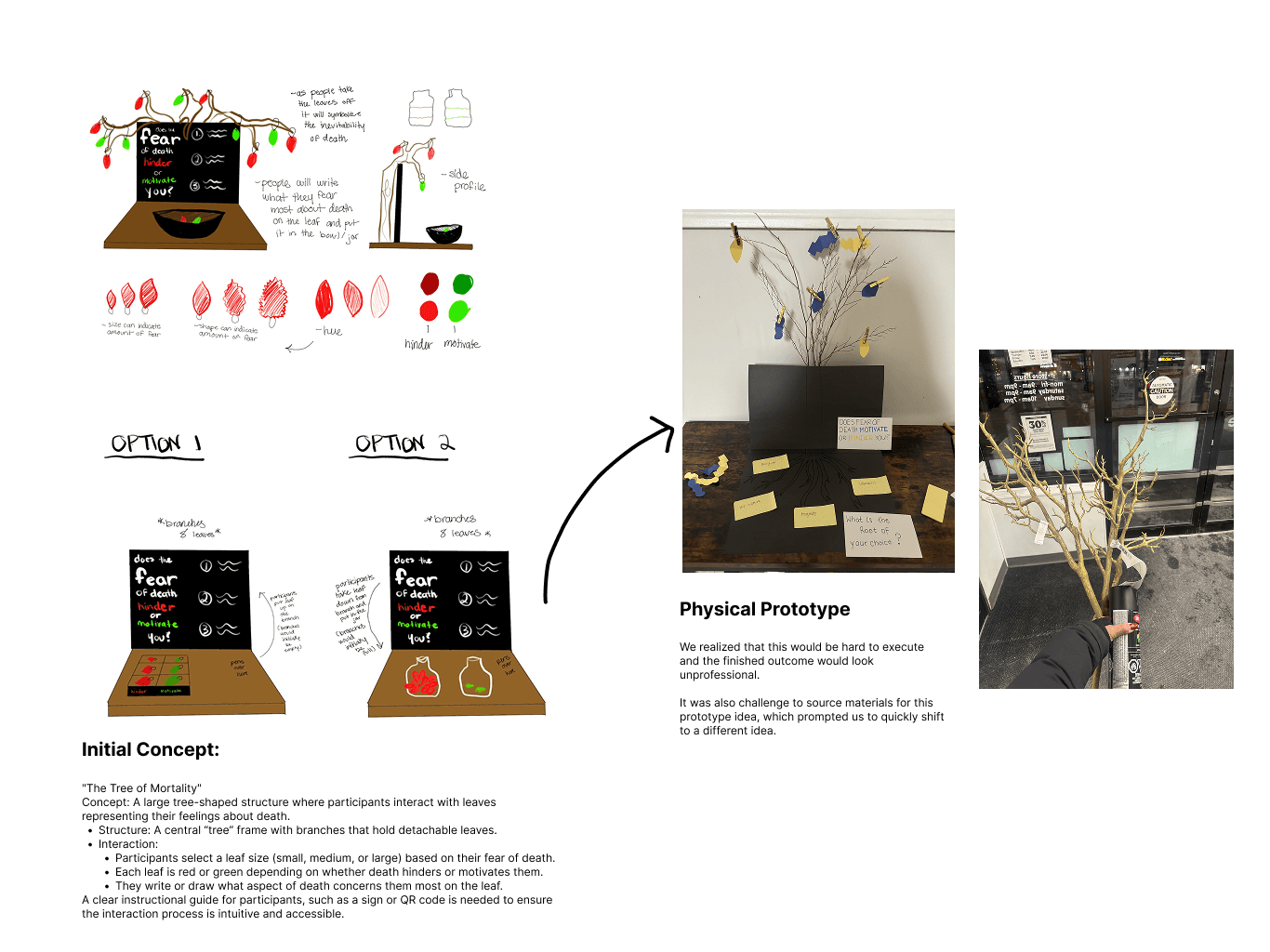
We initially began with a concept that required the audience to pick a leaf depending on its colour for whether death motivated or hindered their life, as well as a certain size of that leaf determined by how much they feared death. With the leaf they chose, they would write why they felt that way about death and then hang it up on the physical branches behind the instructions.

We quickly realized that execution for this would be complicated and hard, and sourcing materials for installation would be a challenge, so we had to accept our failure and go back to the drawing board.


REFINED CONCEPTS

From branches to roots— moving back to the drawing board and finalizing concepts

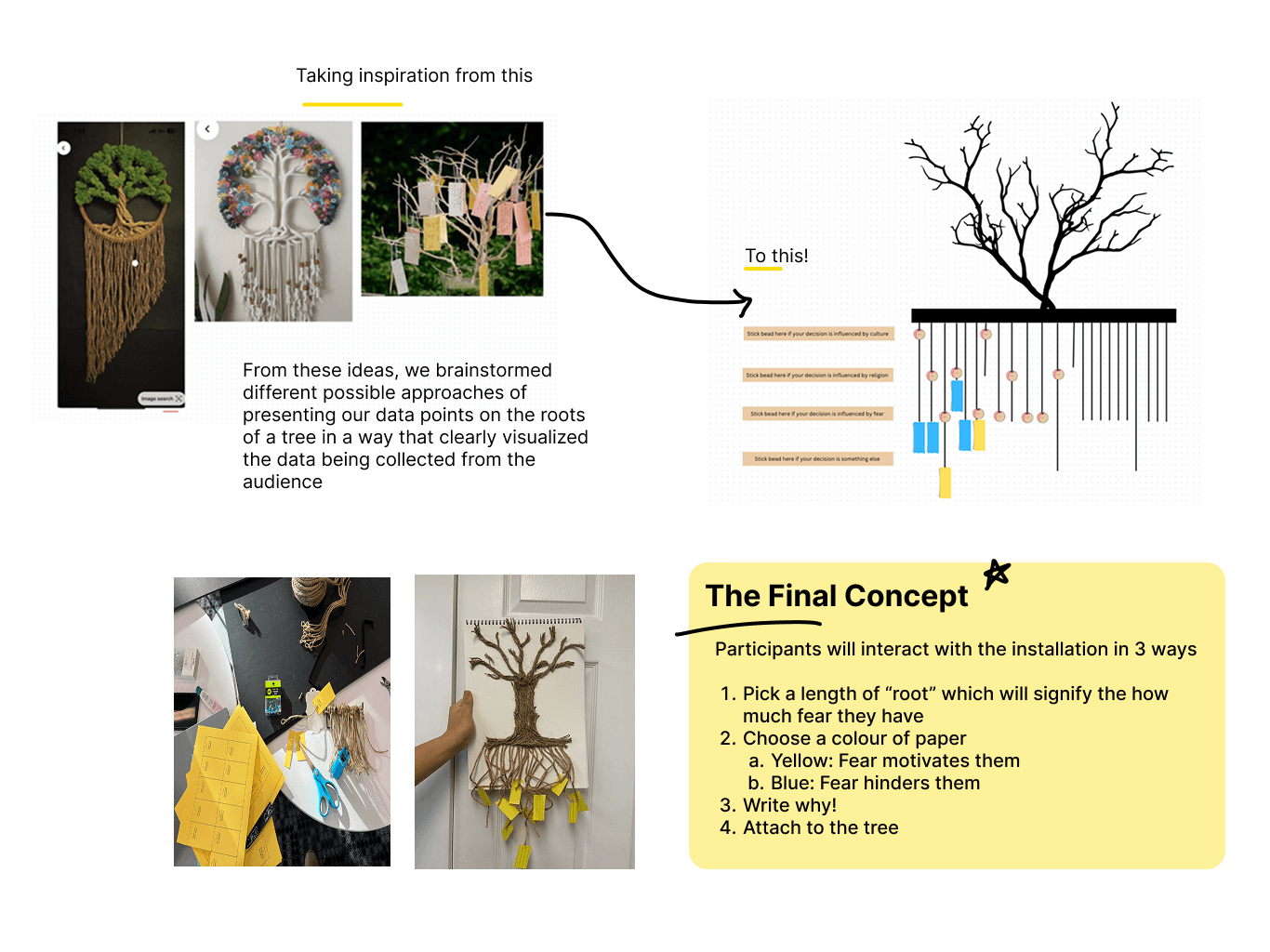
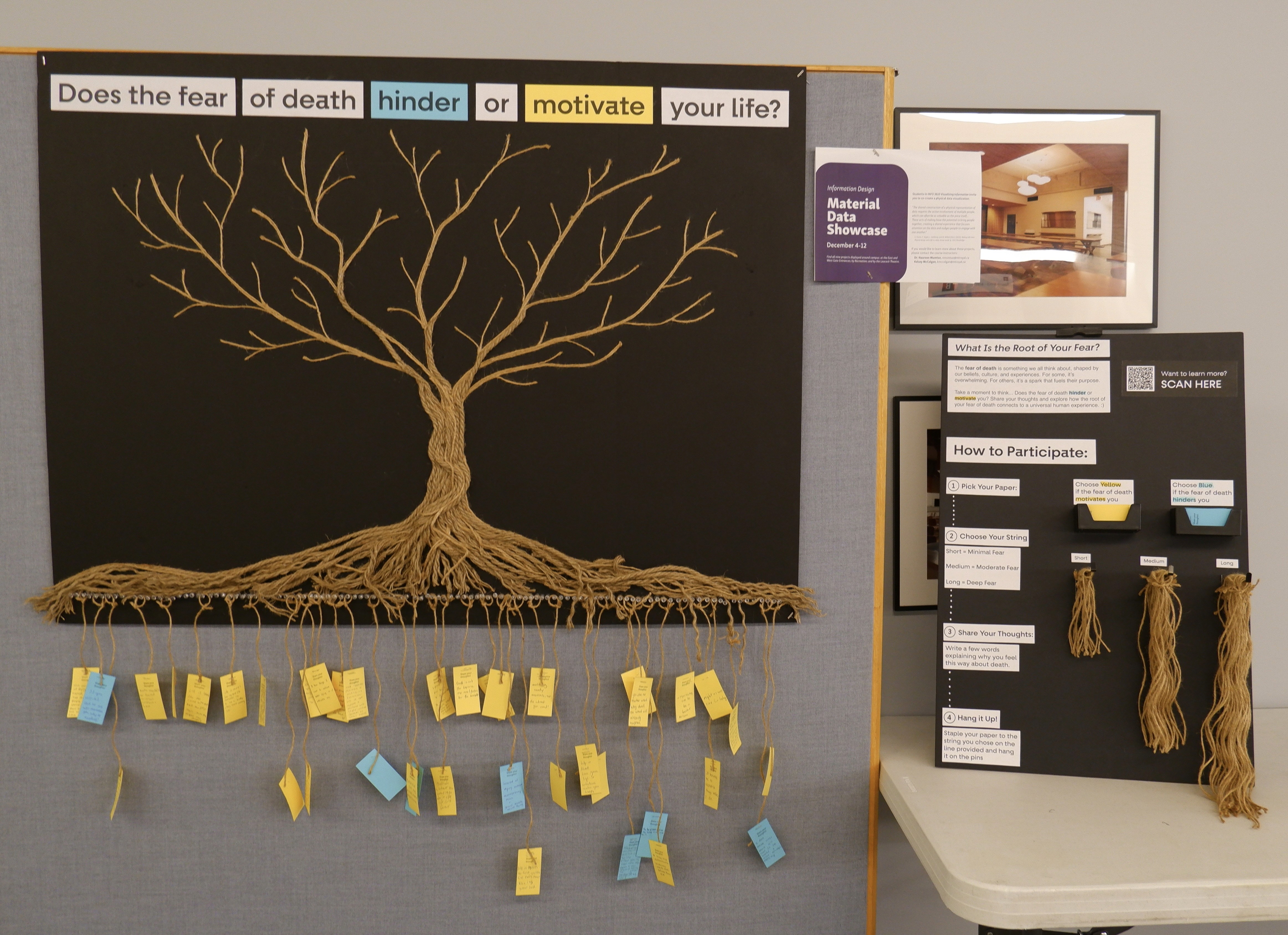
This prototype solidified our ideas of how exactly to showcase our data points in a way that was clear and engaging. We planned to have the varying lengths of roots representing the amount of fear each person felt dangle down below the tree. Having the participants attach the paper slips to the roots instead of hanging leaves on branches was more visually engaging and even further symbolic of our dead tree idea. Lastly, we decided on the idea of using the colours yellow and blue for the pieces of paper, as yellow is a colour that inspires hope, while blue is more melancholic.

DESIGN CHALLENGE

Our challenge was to design a participatory installation that explores life, death, and transition by capturing both numbers and narratives—quantitative and qualitative data—and turning them into a visual story of complex human relationships.


FRAMING THE QUESTION

Does the fear of death hinder or motivate people's lives?

Initially, we envisioned the installation focusing on how religion and culture influence people’s fear of death. But we quickly realized that fear isn’t rooted in just one source—it’s deeply personal and different for everyone. To open the conversation to our diverse MRU community, we invited participants to share their own beliefs and experiences, whatever they might be. Each response captured three things: whether fear of death motivated or hindered their life, how deeply they feared it—minimal, moderate, or deep—and, most importantly, why. These layered perspectives came together to form a collective story of how death influences the way people live.


Our Process


View our process video here


RESEARCH

LITERATURE REVIEW

Measuring Fear: How Much, In What Way, and Why

Scholars highlight that the fear of death can both hinder and motivate. Lagner (2002) found it may lead to avoidance of risks and relationships, yet it can also inspire authentic living and prioritization of what matters most. Gligoric (2024) notes that acknowledging mortality often pushes people to make the most of their time. Cultural perspectives vary—while Zen Buddhism normalizes death as part of life, Western traditions often reinforce fear to maintain order. Cantisano (2020) further shows that fear levels differ widely, shaped by personal, cultural, and religious contexts. These insights shaped our installation design, which measured three variables: fear level, whether it hinders or motivates, and the reason why.


INITIAL CONCEPTS

SKETCHES/ LOW FIDELITY PROTOTYPES

Failing fast…

We initially began with a concept that required the audience to pick a leaf depending on its colour for whether death motivated or hindered their life, as well as a certain size of that leaf determined by how much they feared death. With the leaf they chose, they would write why they felt that way about death and then hang it up on the physical branches behind the instructions.

We quickly realized that execution for this would be complicated and hard, and sourcing materials for installation would be a challenge, so we had to accept our failure and go back to the drawing board.


REFINED CONCEPTS

From branches to roots— moving back to the drawing board and finalizing concepts

This prototype solidified our ideas of how exactly to showcase our data points in a way that was clear and engaging. We planned to have the varying lengths of roots representing the amount of fear each person felt dangle down below the tree. Having the participants attach the paper slips to the roots instead of hanging leaves on branches was more visually engaging and even further symbolic of our dead tree idea. Lastly, we decided on the idea of using the colours yellow and blue for the pieces of paper, as yellow is a colour that inspires hope, while blue is more melancholic.

USER TESTING

WORKING PROTOTYPE

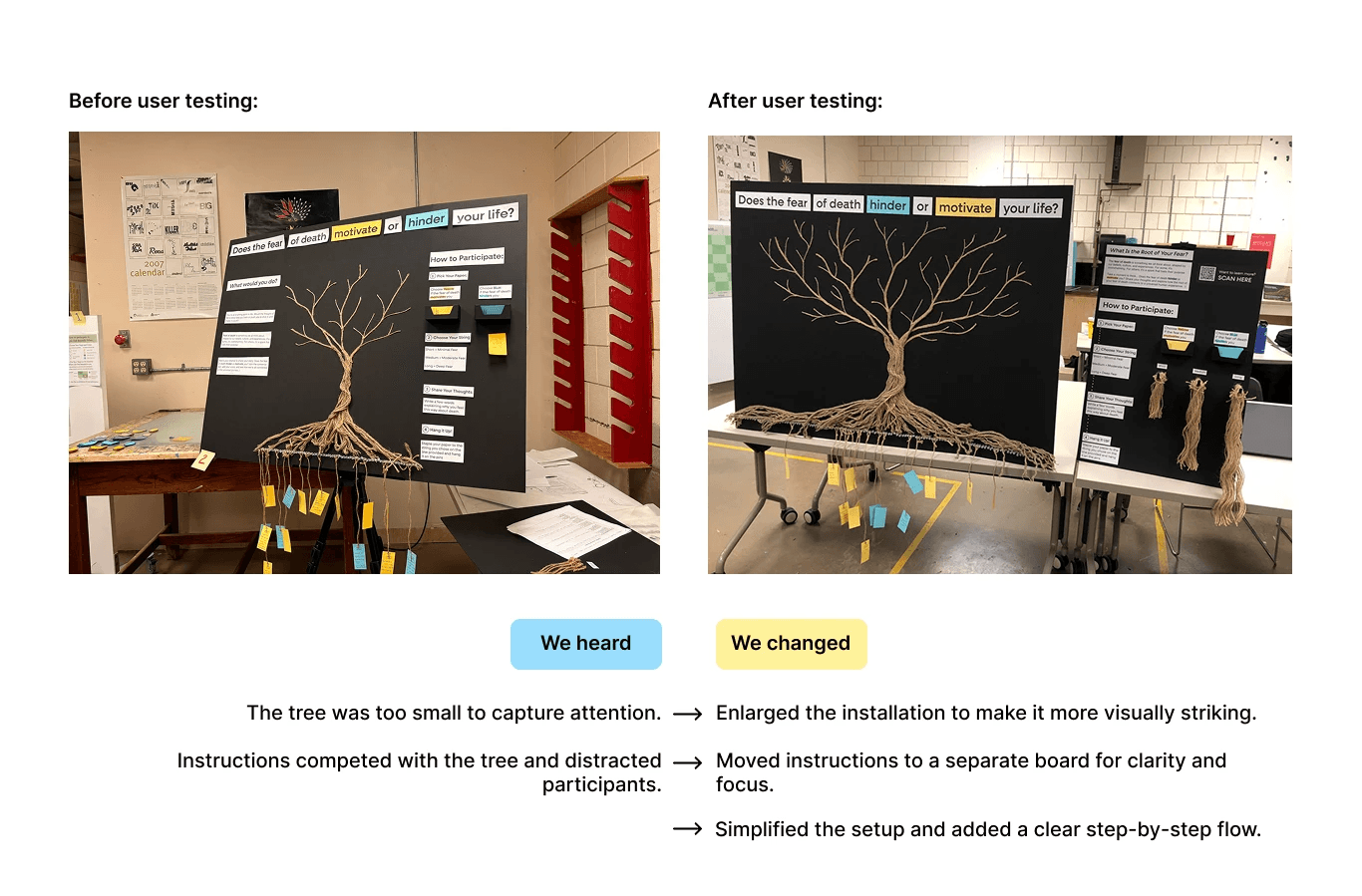
Participants felt that the topic was engaging, but the design needed refinement.

Testing our prototype revealed both strengths and areas for improvement. Participants found the concept engaging and the question meaningful, but they also pointed out issues with scale, clarity, and layout. Their feedback guided us to refine the installation, ensuring the tree became the focal point and the interaction more intuitive.

INSTALLATION

Bringing the tree to life

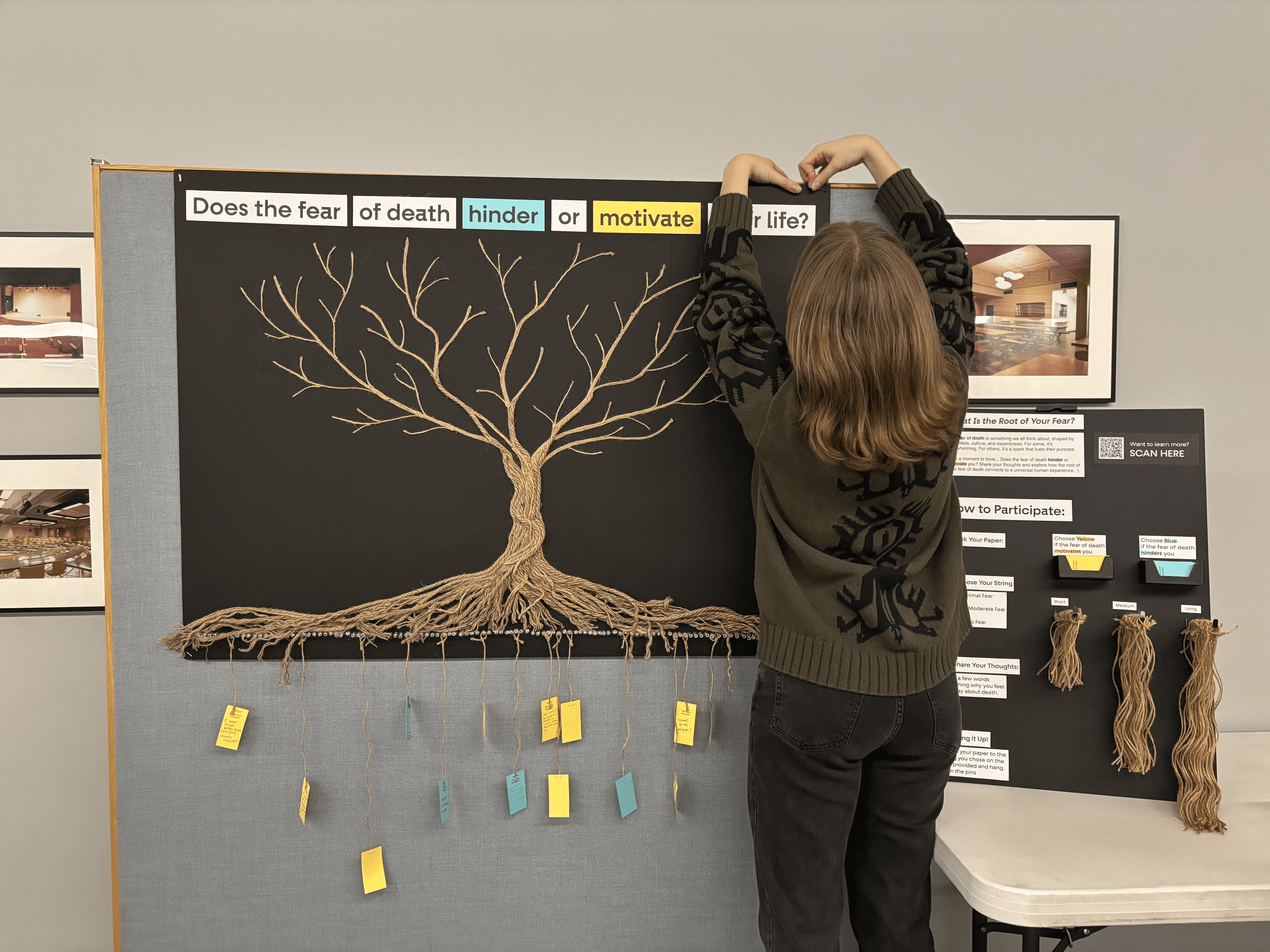
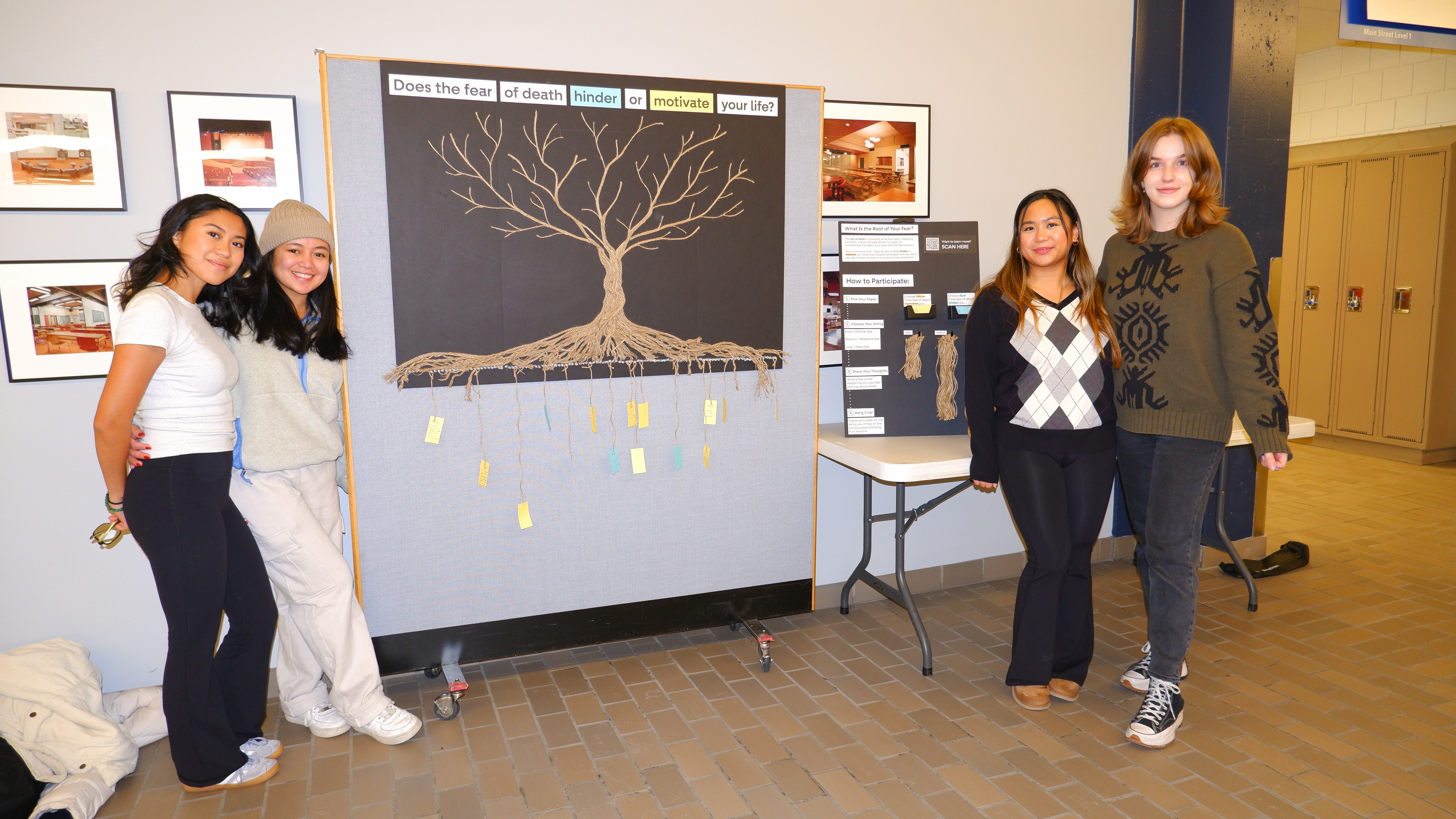
We set up the final installation near the main entrance of our university, inviting passersby to stop, reflect, and contribute. Participants chose a colored slip—yellow for motivate, blue for hinder—and matched it with a string length representing their level of fear. Each response, hung on the tree’s roots, transformed into part of a larger visualization, turning private reflections into a collective story about life and death.
DATA ANALYSIS

DATA CODING

Making sense of the data captured

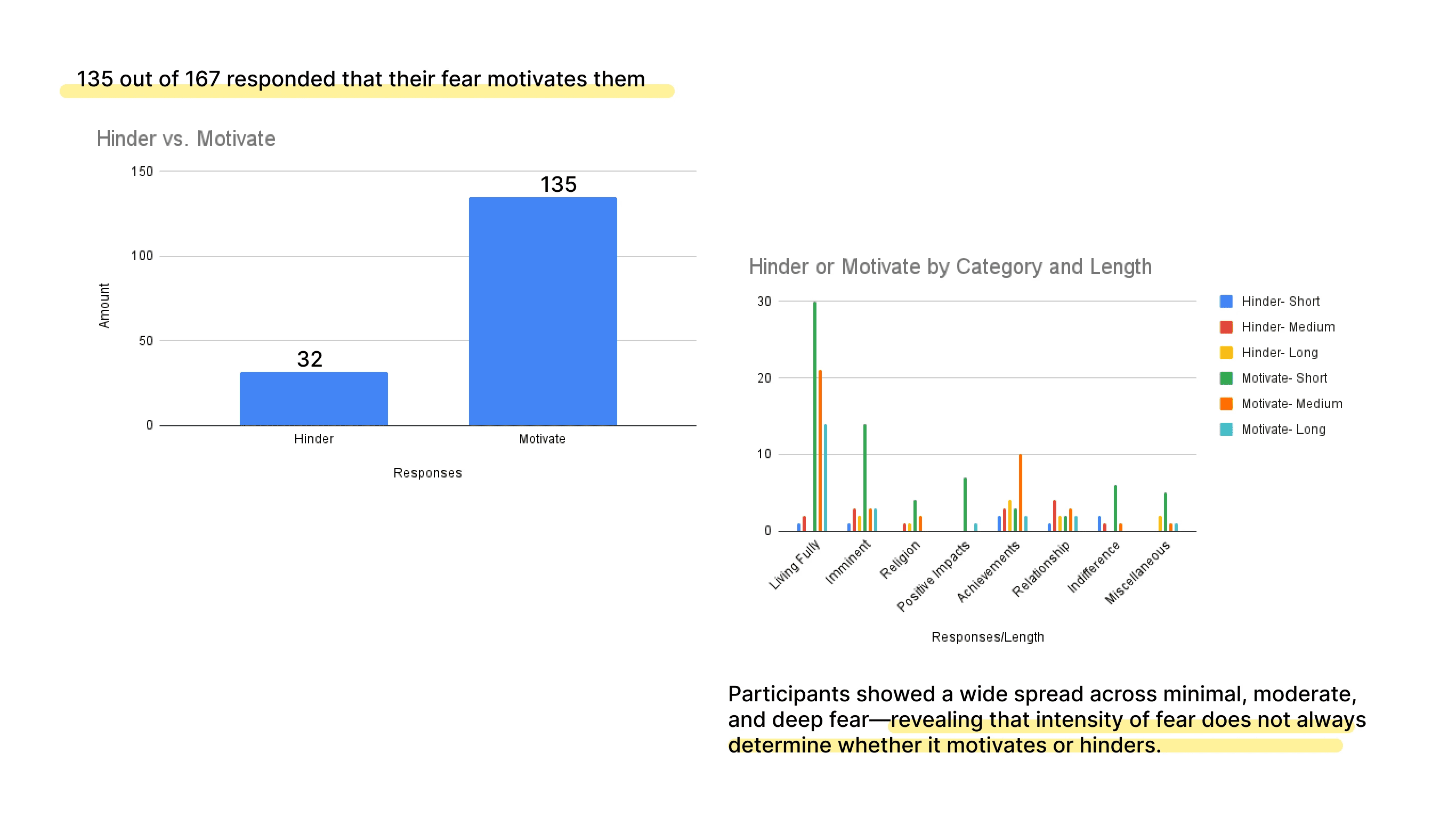
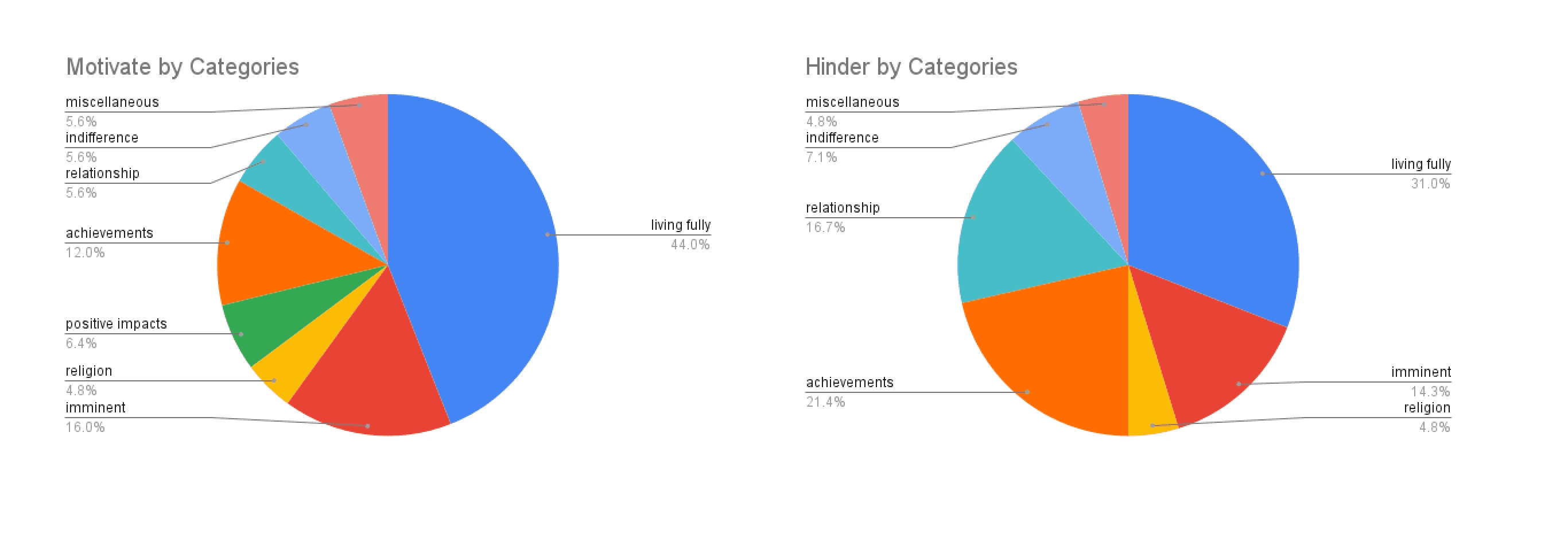
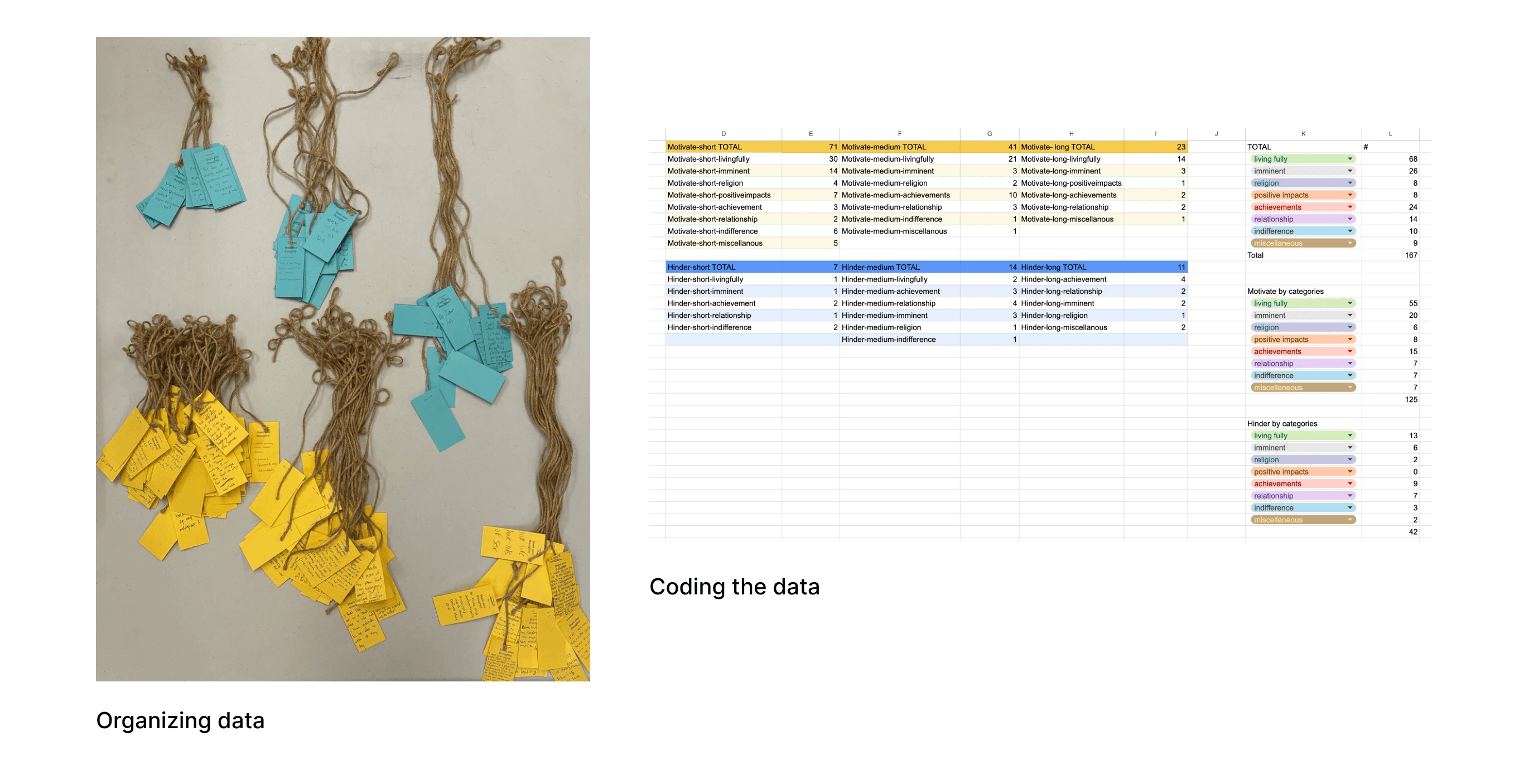
To make sense of the 167 responses, we first sorted slips by hinder vs. motivate and then by string length, representing different levels of fear. Next, we categorized participants’ written reflections into eight themes: living fully, imminent, religion, positive impacts, achievements, relationships, indifference, and miscellaneous. This coding process allowed us to move from raw qualitative responses to clear patterns, revealing both the quantitative breakdown of fear and the deeper reasons behind it.

THE RESULTS

Living fully emerged as the most powerful theme

Across both hinder and motivate, the most prominent theme was living fully. Many participants explained that death motivates them to enjoy life to its fullest, while others felt it hinders them by making life feel fleeting or meaningless. Religion also appeared as a recurring theme, with some finding comfort and purpose in faith, while others expressed greater anxiety tied to religious beliefs. A smaller but powerful set of responses highlighted relationships, where fear was tied not to one’s own death but to leaving loved ones behind. Other themes, such as achievements, positive impacts, and indifference, reflected the diverse ways people frame their lives in relation to mortality.

When viewed together, the data revealed a compelling paradox: while people experience fear of death at different levels, the majority see it as a motivation to live with meaning, connection, and urgency. The installation showed that fear of death is not only a private anxiety but also a shared source of purpose that binds people together.

DATA ANALYSIS

DATA CODING

Making sense of the data captured

To make sense of the 167 responses, we first sorted slips by hinder vs. motivate and then by string length, representing different levels of fear. Next, we categorized participants’ written reflections into eight themes: living fully, imminent, religion, positive impacts, achievements, relationships, indifference, and miscellaneous. This coding process allowed us to move from raw qualitative responses to clear patterns, revealing both the quantitative breakdown of fear and the deeper reasons behind it.

THE RESULTS

Living fully emerged as the most powerful theme

Across both hinder and motivate, the most prominent theme was living fully. Many participants explained that death motivates them to enjoy life to its fullest, while others felt it hinders them by making life feel fleeting or meaningless. Religion also appeared as a recurring theme, with some finding comfort and purpose in faith, while others expressed greater anxiety tied to religious beliefs. A smaller but powerful set of responses highlighted relationships, where fear was tied not to one’s own death but to leaving loved ones behind. Other themes, such as achievements, positive impacts, and indifference, reflected the diverse ways people frame their lives in relation to mortality.

When viewed together, the data revealed a compelling paradox: while people experience fear of death at different levels, the majority see it as a motivation to live with meaning, connection, and urgency. The installation showed that fear of death is not only a private anxiety but also a shared source of purpose that binds people together.

CHALLENGES & REFLECTION

CHALLENGES

Turning obstacles into opportunities to simplify and engage

Throughout the design process, our group faced the challenge of balancing creativity with clarity. Early prototypes often felt too complex or risked appearing unpolished, which pushed us to refine our approach again and again. During installation, we encountered small engagement issues—like participants skipping steps or leaving joke responses—but these moments also highlighted the realities of participatory design. Each challenge became an opportunity to simplify, improve accessibility, and stay true to our goal of creating an installation that was both symbolic and easy to engage with.

REFLECTION

Design is more than just presenting information— it is about inspiring reflection and connection.

Looking back, the project revealed how powerful participatory design can be in making abstract concepts tangible. What began as an exploration of death became a collective story of meaning, motivation, and connection. Many participants shared deeply personal reflections, showing that death is less about fear itself and more about how we define a meaningful life. We were especially proud of how the symbolic choices—roots, strings, and colour—made patterns visible at a glance, turning individual voices into a shared visualization. The experience reminded us that design is not just about presenting information, but also about inspiring reflection and creating space for human connection.
Other projects
Create a free website with Framer, the website builder loved by startups, designers and agencies.